

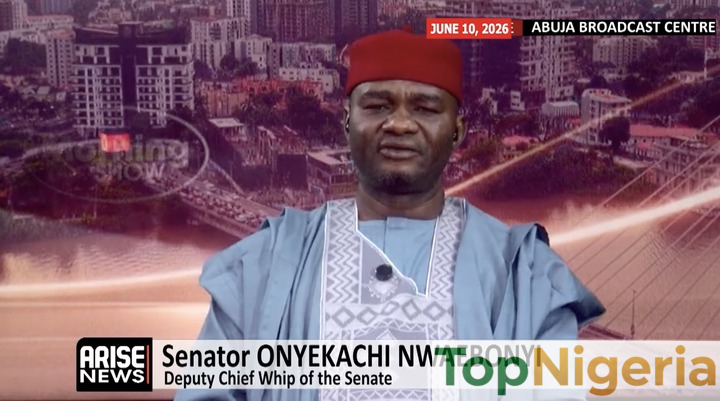
According to a report by Arise News on Wednesday, June 10, 2026, Onyekachi Nwaebonyi, Deputy Chief Whip of the Senate, has defended the credibility of the All Progressives Congress (APC) primary elections, stating that the internal processes of the party remain largely functional and consistent with democratic expectations.
He maintained that the ongoing debates around party primaries should not be interpreted as evidence of institutional collapse but rather as issues that emerge from how political parties manage their internal affairs.
He further explained that the provisions of the Electoral Act, as amended, have significantly reshaped the conduct of party politics in Nigeria.
According to him, the reforms embedded in the law have strengthened internal democracy by shifting greater decision-making authority back to party members, thereby improving transparency and inclusiveness in the selection of candidates who eventually emerge for general elections, including preparations ahead of the 2027 electoral cycle.
Nwaebonyi also argued that while disagreements and disputes may continue to arise during party primaries, such challenges are not necessarily a reflection of weakness in the legal framework guiding elections.
Instead, he suggested that most of the controversies often associated with primaries are rooted in internal party administration, communication gaps, and contestation among aspirants, rather than any failure of electoral laws or institutions responsible for regulating elections in the country.
He made these remarks during an interview with ARISE NEWS on Wednesday, where he was invited to speak on issues surrounding party democracy, electoral reforms, and his political activities.
The senator used the platform to reiterate his belief that Nigeria’s electoral system, particularly under the current legal framework, has evolved in ways that encourage broader participation and reduce the dominance of a few political actors in candidate selection processes.
During the interview, attention was also drawn to criticisms suggesting that he may not have delivered adequately on expectations within his senatorial district.
Responding to the question, Nwaebonyi rejected the claims and insisted that his performance in office was visible and measurable through various development efforts initiated in his constituency.
He pointed to infrastructure projects as key evidence of his legislative impact, particularly road construction initiatives he said were carried out under his representation.
He maintained that such projects were not only functional but also highly visible to residents, emphasizing that they serve as tangible proof of effective representation and accountability to his constituents.
He said: “Even the blind can walk on this 10 kilometres of concrete road I did. They will ask who did this and they will be told it was done by a senator. Tell me any senator in the entire Ebonyi State who has done that number of roads.”