

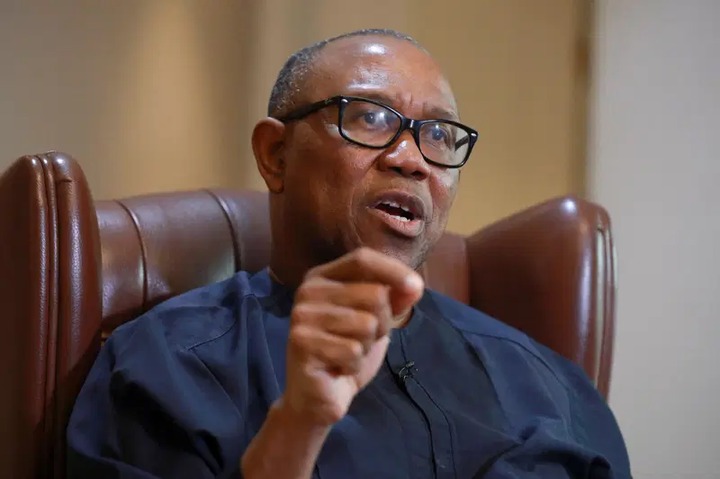
According to a report by Daily Post on Sunday, May 3, 2026, public affairs analyst Babajide Balogun has reacted to the decision of former Anambra State governor and former presidential candidate Peter Obi to leave the African Democratic Congress, describing the development as another sign of instability within opposition politics ahead of the 2027 general elections.
Balogun shared his views shortly after Obi publicly confirmed his departure from the ADC, a party that had recently become part of wider discussions surrounding coalition efforts among opposition figures seeking stronger political cooperation before the next presidential election.
Obi announced his exit from the ADC on Sunday, explaining that his decision was influenced by internal disagreements, political tension, and what he described as a hostile political environment within opposition structures.
He stated that recurring crises, legal disputes, and external interference had created difficulties that distracted from meaningful political engagement and governance discussions.
Obi also emphasized that his decision was not based on personal conflict with any party leader but was connected to broader concerns about the direction of political activities within the opposition movement.
Reacting to the development, Balogun criticized the pattern of frequent movement between political parties by major politicians, arguing that Nigeria’s opposition requires stability and commitment rather than constant political repositioning.
According to him, the country needs political leaders who are willing to remain within a structure, confront challenges directly, and build strong institutions over time.
He suggested that repeated movement from one political platform to another weakens public confidence in opposition politics and creates uncertainty among supporters seeking a credible alternative to the ruling party.
Balogun further argued that the opposition movement in Nigeria should focus on building resilience instead of relying on temporary alliances and strategic exits whenever internal disagreements arise.
He explained that political systems become stronger when leaders are willing to endure difficult moments, resolve disputes internally, and remain committed to long-term organizational growth.
In his view, opposition politics cannot succeed if leading figures continue to abandon platforms whenever tensions develop or coalition arrangements become complicated.
The analyst also expressed concern that divisions and instability within opposition circles may reduce their ability to present a united front in future elections.
According to him, opposition leaders should place greater priority on collective political goals rather than individual calculations or short-term positioning.
He stated that frequent defections and shifting alliances make it difficult for supporters to maintain trust in political movements that are expected to challenge the ruling establishment effectively.
He maintained that Nigeria requires a more disciplined and organized opposition capable of competing consistently within the democratic system.
Balogun also reflected on the possible long-term political implications of Obi’s decisions and political strategy.
He suggested that history may eventually assess the role played by opposition figures in shaping the outcome of future elections, particularly if internal disagreements continue to weaken coalition efforts.
According to him, decisions made by influential politicians today could have lasting effects on the direction of opposition politics and the ability of opposition parties to capitalize on public dissatisfaction with the current administration.
He further stated that the opposition has a responsibility to offer Nigerians a clear and united political alternative rather than repeated cycles of division and uncertainty.
In his view, political ambition should be balanced with commitment to broader democratic objectives.
He argued that supporters often expect opposition leaders to demonstrate consistency, sacrifice, and the willingness to remain within difficult political environments while working toward reform and institutional stability.
The issue of opposition unity has remained a major topic within Nigeria’s political space since the conclusion of the 2023 general elections.
Several politicians and political groups have engaged in discussions aimed at creating stronger alliances capable of challenging the ruling party in 2027.
However, repeated disagreements over leadership, coalition arrangements, and party structure have complicated those efforts.
Obi, former Vice President Atiku Abubakar, and former Kano State governor Rabiu Musa Kwankwaso have all been linked to ongoing consultations involving coalition politics and future electoral strategy.
He said, “When the final chapter of Bola Ahmed Tinubu’s presidency is written, history will not be kind to Peter Obi. It will record, plainly and without sentiment, that his political choices helped fracture a winnable opposition and paved the way for the very outcome his supporters now lament.”