
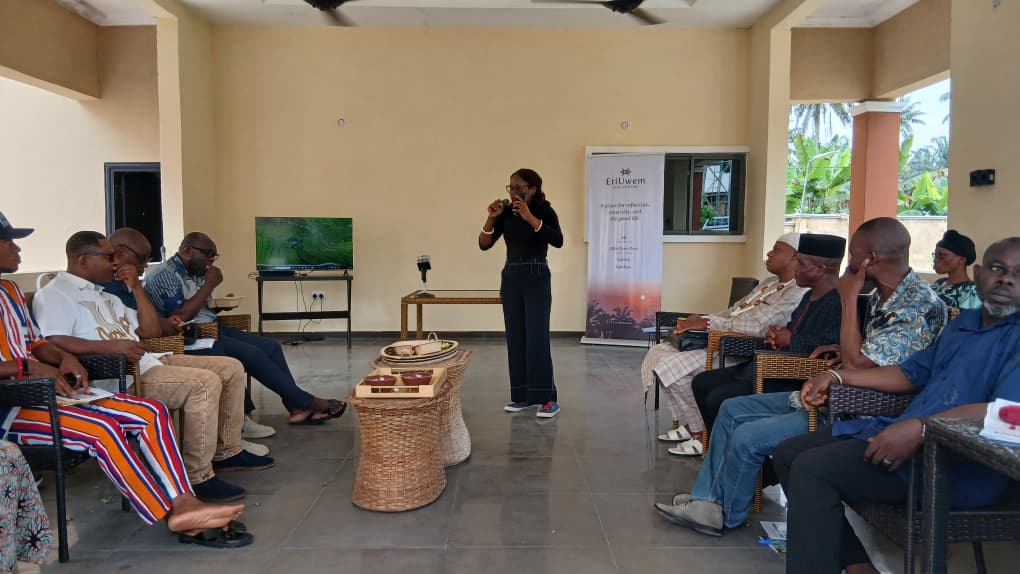
John said the community, until HOMEF’s intervention, did not know how to respond to the spill.
“When oil pollution occurs, when oil comes out from the ground, it is something we did not understand. This foundation came and enlightened us,” he said, adding that the village will now organise to document and report the spills.
For Bassey Henry of Uyo Afaha Nkan Village in Ikono, the impact is visible on every rooftop and farm.
According to him, “Roofing sheets in the area do not last up to five years, while palm trees have stopped producing fruits as they once did. Crops such as cocoyam, cassava and yam often withered in the ground before harvest. While okro and other vegetables cannot have good yield in the area,” he said.
“Millipedes, snails and fishes have gone extinct because of the effect of this pollution on our environment,” Henry added.
Another villager from Ikono, Namonso Nya, lamented: “Villagers in these communities where these corked well heads are suffering; go to these communities, nothing grows again. SPDC should come in and compensate the people; it has affected lives. Most of the diseases we suffer today – cancer, high blood pressure are because of this oil of a thing.”
Most of the people interviewed have similar reports of living with the consequences of leaking corked heads, which included poisoned streams, barren farmlands, dying economic trees, vanishing aquatic life and a new wave of insecurity.
Beyond the pollution, Friday John painted a picture of total neglect, saying, “There is no hospital; if there is any medical emergency, before we can take patients to the city of Uyo, they die on the way because there is no road, no light, no hospital, no facilities, nothing. Even good water to drink can’t be found”.
On his part, Executive Director of HOMEF, Dr Nnimmo Bassey, stated that the wells in Ikono and Ibiono Ibom were drilled and subsequently capped by Shell in the 1950s after they were deemed commercially unviable, adding that although commercial extraction is no longer taking place, residents said the physical and environmental consequences have persisted.
He described abandoned oil wells in the Niger Delta as “ticking time bombs” threatening the environment, health and livelihoods.
“There is an urgent need for the decommissioning of abandoned oil wells. An oil company may stop producing from a well, but that does not mean its environmental responsibility disappears,” he said.
”An abandoned well remains dangerous infrastructure. It can deteriorate, it can be infiltrated, and it can pose environmental and safety risks. That is why abandoned oil wells require proper assessment, monitoring, and decommissioning.”
”Communities living beside oil facilities need to know what is happening to their environment. What has been spilled? What chemicals are present? Is the water safe? What are the health risks? Who is responsible? And what is being done about it? Environmental decisions should not happen without the people who live with their consequences,” he said.
Bassey said environmental justice is more than clean-up, noting that ”Environmental justice requires more than cleaning up after a disaster. It requires prevention. It requires monitoring. It requires reparation. It requires transparent information. It requires meaningful community participation. And where oil infrastructure is no longer in use, it requires proper decommissioning and dismantling. Where pollution has occurred, there must be remediation and restoration. Destructive extractivism in the Niger Delta must stop,” he said.
“HOMEF is calling on the Federal Government, Shell, the Nigerian Upstream Petroleum Regulatory Commission, NUPRC, and the Akwa Ibom State Government to address outstanding claims concerning the abandoned Ikono 1 well, including environmental remediation, compensation and restoration,” Bassey added.