

I would say, as a young boy growing up in the early 90s, during the aborted Third Republic in my native Ukako home in Okeneba, Okene Local Government Area of Kogi State, I was politically enlightened enough to understand one hard truth early in life, politics is all about interest.
Over the years, I have also come to realise that this reality is not peculiar to Nigeria alone. Across some of the world’s biggest democracies, political children have repeatedly chosen personal ambition, ideology or strategic interest over family political loyalty.
In the United States, conservative commentator Christian Walker openly criticised and distanced himself from his father, Republican Senate candidate Herschel Walker, during the Georgia Senate race.
In Canada, political generations within the Trudeau family evolved differently over time despite sharing the same famous political surname.
In the United Kingdom and other European democracies, political families have also witnessed ideological divisions across generations, proving that politics is often driven more by conviction and opportunity than by blood ties.
But long before I understood global political contradictions, I first witnessed it firsthand inside my own family compound during Nigeria’s military transition to democracy.
This was the era when Chief Moshood Kashimawo Olawale Abiola of the SDP and Alhaji Bashir Tofa of the NRC battled for the presidency in the historic June 12, 1993 election later annulled by the military government of General Ibrahim Badamasi Babangida.
Before that election, the strong bond between my father, Alhaji Ozumi Dauda, and his younger brother, Alhaji Muhammad Sani collapsed almost completely because of politics.
While my father was a loyal chieftain of the NRC under the late Alhaji Usman Bello’s political structure in Kogi Central, my uncle belonged fully to the SDP family led by the late Alhaji Usman Obatemi.
Our family compound became a political headquarters and Mecca for two rival parties.
Supporters of the NRC and SDP flooded the same compound daily. Meetings held in different corners of the house. Oh! What a memory. I could recall with a vivid nostalgia that arguments became routine then. On some occasions, both men almost exchanged blows.
Cross party posters were tore off the perimeters of the wall of the compound in retaliations. Yet these were brothers who once ate together from the same plate, exchanged cars freely and even travelled to Saudi Arabia together for Hajj years earlier.
Politics temporarily separated what blood had built. It was a case of blood versus ballot.
But immediately after the annulment of the election, peace gradually returned. The anger disappeared. Brotherhood resurfaced.
That experience taught me something enduring: in politics, interest often comes before bloodline.
Decades later, Nigeria’s political circle continues to reflect that same reality, as children of powerful politicians increasingly carve out independent political identities, sometimes directly opposing their fathers’ political camps or openly aligning with their fathers’ biggest rivals.
Perhaps no example captures that reality more dramatically today than Abdulaziz Umar Ganduje, son of former Kano governor and ex-APC National Chairman Abdullahi Umar Ganduje.
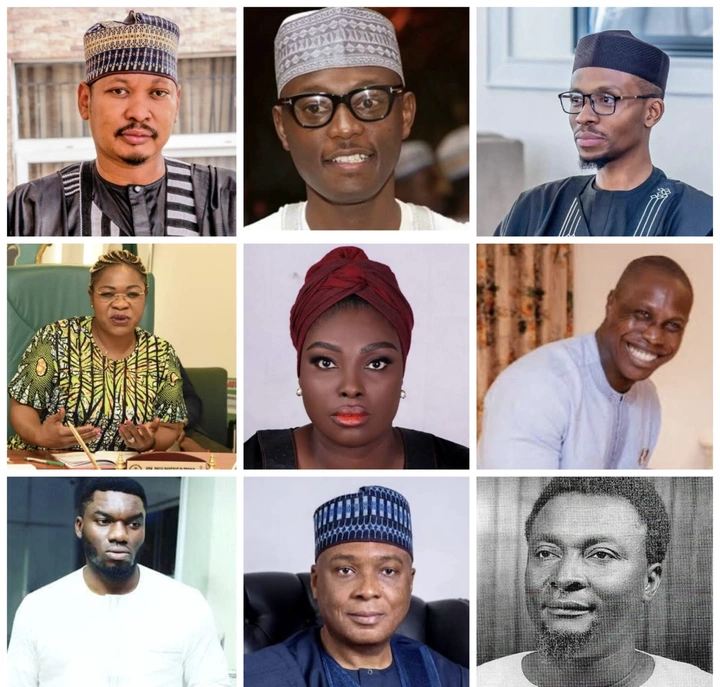
Below Are the Children of Nigerian Politicians in Their Father’s Enemies’ Camp:
Abdulaziz Ganduje and the Kwankwaso Political Camp
In what many political observers now describe as one of Kano’s biggest political twists ahead of 2027, Abdulaziz Ganduje formally dumped the APC political family structure and secured the National Democratic Congress (NDC) ticket to contest for the House of Representatives seat for Dawakin Tofa/Tofa/Rimin Gado Federal Constituency in Kano State.
What made the development more explosive was not just his defection, but the fact that the NDC has become politically associated with the growing political movement of Rabiu Musa Kwankwaso, Ganduje’s longtime political enemy and former ally turned arch rival.
For many in Kano, it was more than an ordinary political move. It was symbolic.
The Ganduje-Kwankwaso rivalry has shaped Kano politics for nearly a decade, splitting political loyalists, traditional institutions and even families across the state. Seeing Ganduje’s own son openly align with Kwankwaso’s political structure reinforced once again that political interest often overrides family loyalty.
Abba Atiku Abubakar
Another striking example is Abba Atiku Abubakar, son of former Vice President Atiku Abubakar.
Abba reportedly distanced himself from his father’s PDP political structure and aligned with the ruling APC, openly identifying with President Bola Ahmed Tinubu while his father remained one of the strongest opposition voices against the ruling party.
For many observers, it was another reminder that children of politicians increasingly pursue personal political calculations independent of family traditions.
Bello El-Rufai and Nasir El-Rufai
Former Kaduna governor Nasir El-Rufai also found himself politically separated from his son, Bello El-Rufai.
While the elder El-Rufai drifted toward opposition coalition politics outside the APC framework, Bello El-Rufai remained firmly rooted within the APC establishment as a serving member of the House of Representatives.
It was one of the clearest recent examples of father and son operating from different political camps despite sharing the same political surname.
David Mark and Blessing Onuh
Former Senate President David Mark and his daughter Blessing Onuh also found themselves on different political paths.
While David Mark became associated with opposition coalition politics, his daughter remained active within the APC structure and sustained her political career under the ruling party.
James Ibori and Erhiatake Ibori-Suenu
Former Delta State governor James Ibori spent years as one of the PDP’s strongest political pillars in the South-South.
However, his daughter, Erhiatake Ibori-Suenu, later pitched her tent with the APC after previously operating within the PDP.
Again, ambition and political survival appeared stronger than inherited political loyalty.
Olusegun Obasanjo and Juwon Obasanjo
Former President Olusegun Obasanjo also experienced public political divergence within his family.
While Obasanjo openly criticised the APC government at different periods, his son Juwon Obasanjo publicly campaigned for former President Muhammadu Buhari and identified strongly with the APC political structure.
Doyin Okupe and Ditan Okupe
Late presidential aide Doyin Okupe and his son Ditan Okupe also found themselves politically divided during the 2019 elections.
While Doyin Okupe backed the PDP, his son openly supported Muhammadu Buhari and the APC government.
Bukola Saraki and the Saraki Dynasty
Nigeria’s famous Saraki political dynasty equally witnessed internal political fractures.
The late Olusola Saraki and his son, former Senate President Bukola Saraki, eventually disagreed politically during the succession battle over Kwara State politics.
At a point, Bukola Saraki backed Governor Abdulfatah Ahmed while his father supported Gbemi Saraki under another political platform.
Alvan Ikoku and Samuel Goomsu Ikoku
Even Nigeria’s First Republic experienced similar political divisions.
Samuel Goomsu Ikoku once contested against his own father, Alvan Ikoku, during an Eastern House of Assembly election, representing opposing political tendencies. He eventually defeated his father at the polls.
From outsiders, it’s blood first, but to these politicians’ children, their preference is ballot. But what do we know? We can’t cry more than the bereaved.