

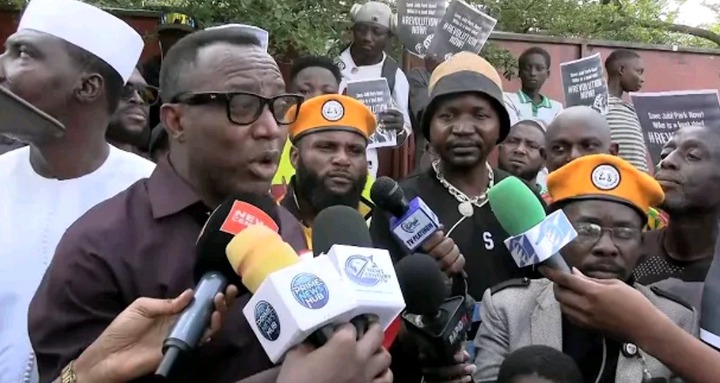
Human rights activist and former presidential candidate Omoyele Sowore has criticized the Minister of the Federal Capital Territory, Nyesom Wike, over reported demolition exercises and alleged seizure of properties belonging to residents in parts of Abuja.
Sowore made the remarks in a video referenced by TV Platinum on Thursday, May 14, 2026, where he expressed concern about the impact of enforcement actions on low-income residents in the Federal Capital Territory.
The activist accused authorities of focusing disproportionately on ordinary Nigerians while allegedly ignoring influential individuals and wealthy property owners. According to him, poor citizens often bear the brunt of government policies and enforcement operations.
Reacting to the issue, Sowore said, “They are always after what the poor people have. That is their interest.”
The former presidential candidate argued that many struggling Nigerians spend years working to build homes, establish businesses, and secure livelihoods, only to face the possibility of losing everything through sudden demolitions or government interventions.
According to him, authorities should place greater emphasis on improving living conditions and protecting vulnerable citizens rather than implementing measures that increase hardship.
Sowore also expressed concern over what he described as a growing pattern of demolition exercises and land-related disputes affecting low-income communities in the Federal Capital Territory. He suggested that such actions have intensified public frustration and reinforced perceptions of inequality within the system.
The activist maintained that enforcement measures often appear to affect ordinary residents more severely than wealthy individuals or politically connected property owners. He argued that this perception has fueled anger among Nigerians who believe that the powerful are frequently protected while the poor face harsh consequences.
His comments have since generated widespread reactions on social media, with many users supporting his criticism and arguing that low-income residents are often the most vulnerable during urban redevelopment and enforcement exercises.
Some supporters of Sowore insisted that housing policies and demolition operations should be implemented with greater sensitivity to the welfare of affected communities. Others argued that the government should prioritize compensation, relocation plans, and dialogue with residents before carrying out demolitions.
However, some Nigerians defended the enforcement activities taking place in Abuja, maintaining that authorities have the legal right to remove illegal structures or reclaim lands where necessary, regardless of the status of the owners involved.
Supporters of the ongoing actions also argued that urban planning regulations must be enforced to ensure orderly development and protect public infrastructure within the nation’s capital.
The debate has reignited broader discussions about housing rights, urban development policies, and social inequality in Nigeria, particularly within rapidly expanding cities like Abuja where disputes over land ownership and demolition exercises frequently generate controversy.
Sowore, who has consistently positioned himself as a vocal critic of government policies and social injustice, has often spoken against actions he believes disproportionately affect ordinary Nigerians. Through his activism and political engagements, he has repeatedly advocated for accountability, social protection, and equal treatment under the law.
His latest remarks add to ongoing conversations surrounding governance and the management of urban development in the Federal Capital Territory under the leadership of Wike.
As reactions continue to emerge, the issue has remained a major topic of discussion online, with many Nigerians divided over the balance between enforcing city planning regulations and protecting the rights and welfare of vulnerable residents in the country’s capital city.