
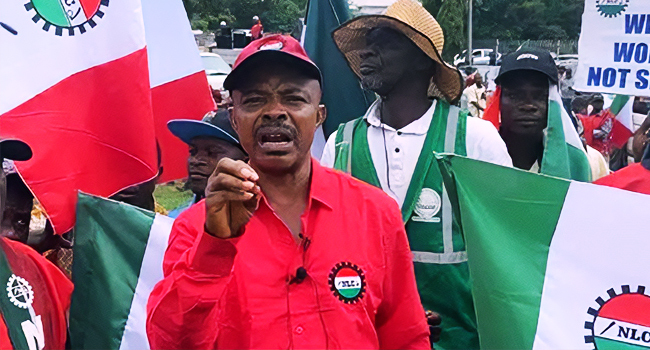
The Nigeria Labour Congress (NLC) has insisted that Nigerian workers remain under severe economic pressure despite the implementation of the N70,000 national minimum wage, maintaining its two-week ultimatum to the Federal Government over rising petrol prices and fresh wage negotiations.
NLC President Joe Ajaero stated the union’s position on Monday in Abuja, where he criticised the implementation of the 2024 minimum wage agreement and urged the government to introduce urgent measures to ease workers’ hardship.
His remarks came amid growing tensions between organised labour and the Federal Government over declining purchasing power, rising transportation costs and the increasing difficulty of meeting basic household expenses.
Ajaero maintained that the labour movement would not withdraw its ultimatum, arguing that the government should address workers’ concerns before they escalate into strikes or protests.
He spoke as government officials called for a sustainable wage system that balances workers’ welfare with public finances and the country’s broader economic development objectives.
NLC Says Workers Can No Longer Cope With Rising Living Costs
Ajaero said Nigerian workers were struggling to meet their basic needs despite the minimum wage increase agreed upon in 2024.
He argued that rising petrol prices and transportation costs had weakened the purchasing power of workers, leaving many unable to afford essential goods and services.
Addressing government officials at a retreat in Abuja, the NLC president stressed that the purpose of organised labour’s demands was to secure meaningful relief for workers rather than provoke an industrial dispute.
“The point we are making is not strike. The point we are making is that whether you enter bus or you buy fuel, you will not be able to eat,” Ajaero said.
He urged the government to introduce timely interventions to cushion the effects of economic hardship, rather than waiting until labour unions mobilise for industrial action.
According to him, governments in other countries often introduce measures to protect workers’ welfare before disputes escalate.
“But to wait for Labour to be on the street before we address this is not really what is happening all over the world,” he said, calling on the Federal Government to be more proactive.
NLC Maintains Two-Week Ultimatum Over Petrol Prices
The labour movement had issued a two-week ultimatum demanding a reduction in petrol prices and the commencement of fresh negotiations on the national minimum wage.
Ajaero confirmed that discussions and exchanges of correspondence had taken place between organised labour and government officials. However, he maintained that the ultimatum remained in force.
He explained that the retreat was not the appropriate forum to negotiate the ultimatum, despite the presence of senior government officials.
“I’ve not come here to discuss my ultimatum. My ultimatum stands,” the NLC president said.
He appealed to the government and relevant public institutions to take workers’ concerns seriously and pursue solutions that would prevent further deterioration in industrial relations.
Ajaero also called on officials to recognise the long-term consequences of failing to address workers’ welfare.
Ajaero Disputes Claims of 133 Per Cent Salary Increase
The NLC president also challenged claims that federal public servants received salary increases of approximately 133 per cent following the 2024 minimum wage negotiations.
According to Ajaero, the adjustment involved adding N40,000 to the salaries of federal public service workers, which he argued did not amount to the percentage increase being attributed to the agreement.
“Forty thousand does not translate to 100 per cent or 133 per cent. And the consequences are what we are facing now, sir,” he said.
Ajaero maintained that the adjustment had not provided adequate relief amid rising inflation and higher transportation expenses.
He argued that wage negotiations should deliver meaningful improvements in workers’ living standards rather than rely on headline figures that might not reflect their actual purchasing power.
The NLC’s position underscores the continuing debate over whether the N70,000 minimum wage remains adequate under prevailing economic conditions.
NLC Raises Concerns Over Unresolved Labour Disputes
Ajaero also expressed concern about unresolved industrial disputes affecting public sector workers.
He recalled an 84-day strike by health sector workers that was suspended following the intervention of organised labour, but said the issues that prompted the industrial action had yet to be adequately addressed more than a year after the intervention.
He further disclosed that workers under the National Public Service Negotiating Council had considered industrial action before labour leaders persuaded them to suspend their plans.
The NLC president rejected suggestions that politicians were using organised labour to advance political interests.
He described such allegations as insulting to workers who were demanding better salaries and improved living conditions.
“No politician can use us. That’s the greatest insult, to tell me at this age and time, you know, to say a politician is using you when you ask for increase of workers’ salaries,” he said.
Ajaero nevertheless expressed willingness to participate in discussions aimed at improving wage administration and resolving outstanding concerns.
FG Calls for Balance Between Workers’ Welfare and Fiscal Capacity
Meanwhile, Secretary to the Government of the Federation George Akume called for a balance between workers’ legitimate demands for improved remuneration and the government’s financial capacity.
Akume, represented by the Permanent Secretary of the General Services Office in the Office of the Secretary to the Government of the Federation, Dr Abubakar Kana, said wage decisions must reflect economic realities while supporting industrial harmony.
“The commission must continually balance the legitimate expectations of workers with the fiscal realities of government and broader imperatives of national economic development,” he said.
Akume noted that economic reforms, rising public expectations and the approaching 2027 general elections had increased the importance of developing a fair and sustainable wage system.
He urged the National Salaries, Incomes and Wages Commission to improve policy coordination, embrace digital transformation and strengthen the implementation of institutional reforms.
He also warned against avoidable industrial disputes, emphasising that dialogue and cooperation were necessary to maintain economic stability.
According to him, the commission should strengthen its research and data management processes, establish clear implementation timelines and adopt measurable performance indicators.
He urged its newly constituted board and management to ensure that decisions reached at the retreat translated into practical improvements.
Wages Commission Seeks Sustainable Salary Policies
Earlier, the Chairman and Chief Executive Officer of the National Salaries, Incomes and Wages Commission, Junaidu Bindawa, said Nigeria’s economic conditions required a more strategic approach to wage administration.
Bindawa explained that inflationary pressures, changing labour expectations and demands for greater public sector efficiency had increased the importance of sustainable salary policies.
He noted that wage administration affected workers’ welfare, public expenditure, industrial relations, productivity and the overall performance of the public service.
“Our work must reflect a careful balance between the legitimate expectation of workers, the imperatives of productivity and social justice, and the physical capacity of government,” he said.
The chairman said the retreat, themed Vision, Strategy and Institutional Renewal, was designed to reposition the commission to address emerging wage and compensation challenges more effectively.
He identified research, job evaluation, compensation management, public finance, industrial harmony and institutional accountability as key areas requiring attention.
Bindawa also called for stronger collaboration between the commission’s board and management, improved internal systems and the adoption of digital tools to support evidence-based decisions.
He said the retreat should produce a practical roadmap with clear priorities and measurable outcomes.
Commission Advocates Data-Driven Wage Reviews
In her welcome remarks, the commission’s Secretary, Olajumoke Okoya-Thomas, called for a permanent, evidence-based approach to wage reviews rather than a system driven by emergencies.
She recalled that earlier wage review exercises were conducted through temporary commissions, including the Morgan Commission of 1964, the Adebo Commission of 1971 and the Udoji Commission of 1974.
According to her, the establishment of the National Salaries, Incomes and Wages Commission in 1993 provided a permanent institutional framework for advising the government on salaries, allowances and national incomes policy.
“We exist so that wage decisions rest on evidence, not emergencies,” she said.
Okoya-Thomas acknowledged that the 2024 minimum wage more than doubled the previous statutory minimum but stressed that future wage decisions must remain fair, informed and sustainable.
She said the retreat would examine data reliability, fair remuneration, social dialogue, institutional capacity and governance.
The commission also plans to develop an action plan aligned with the Renewed Hope Agenda, Nigeria Agenda 2050 and the Medium-Term National Development Plan for 2027 to 2030.
According to her, the plan would establish specific responsibilities, implementation timelines and performance indicators, with the monitoring and evaluation division tracking progress.
Head of Service Links Workers’ Welfare to Economic Growth
Also speaking, the Head of the Civil Service of the Federation, Abel Enitan, said improved workers’ welfare, institutional efficiency and the modernisation of government operations were essential to national development.
He described salary administration as a matter of national interest, noting that the civil service and the wages commission had complementary responsibilities in improving working conditions and public sector performance.
Enitan said the government was prioritising capacity development and the digitisation of civil service operations, with the aim of establishing a fully paperless working environment.
He linked public service reforms to President Bola Tinubu’s ambition to build a $1 trillion economy by 2030, arguing that achieving the target would require a productive and well-equipped workforce.
“It is achievable. Just that the workforce must be mobilised behind that agenda,” he said.
Enitan identified efficiency, productivity, integrity and citizen-centred service delivery as essential attributes of a modern civil service.
He expressed confidence that the retreat would produce recommendations to strengthen wage administration, improve workers’ welfare and support broader public service reforms.
Outlook for Minimum Wage Negotiations
The latest exchange between organised labour and government officials highlights the challenge of reconciling workers’ demands for better living standards with the government’s fiscal constraints.
While the NLC is insisting on petrol price relief and fresh wage negotiations, the government has emphasised sustainable remuneration, economic development and the prevention of industrial disputes.
The immediate concern for workers remains the effect of rising living costs on the real value of their earnings.
With the NLC maintaining its two-week ultimatum, further engagement between labour representatives and the Federal Government will be important in determining whether the dispute can be resolved through dialogue.
Until concrete measures address workers’ concerns, the adequacy of the N70,000 minimum wage and the cost of transportation are likely to remain central issues in Nigeria’s labour relations.