
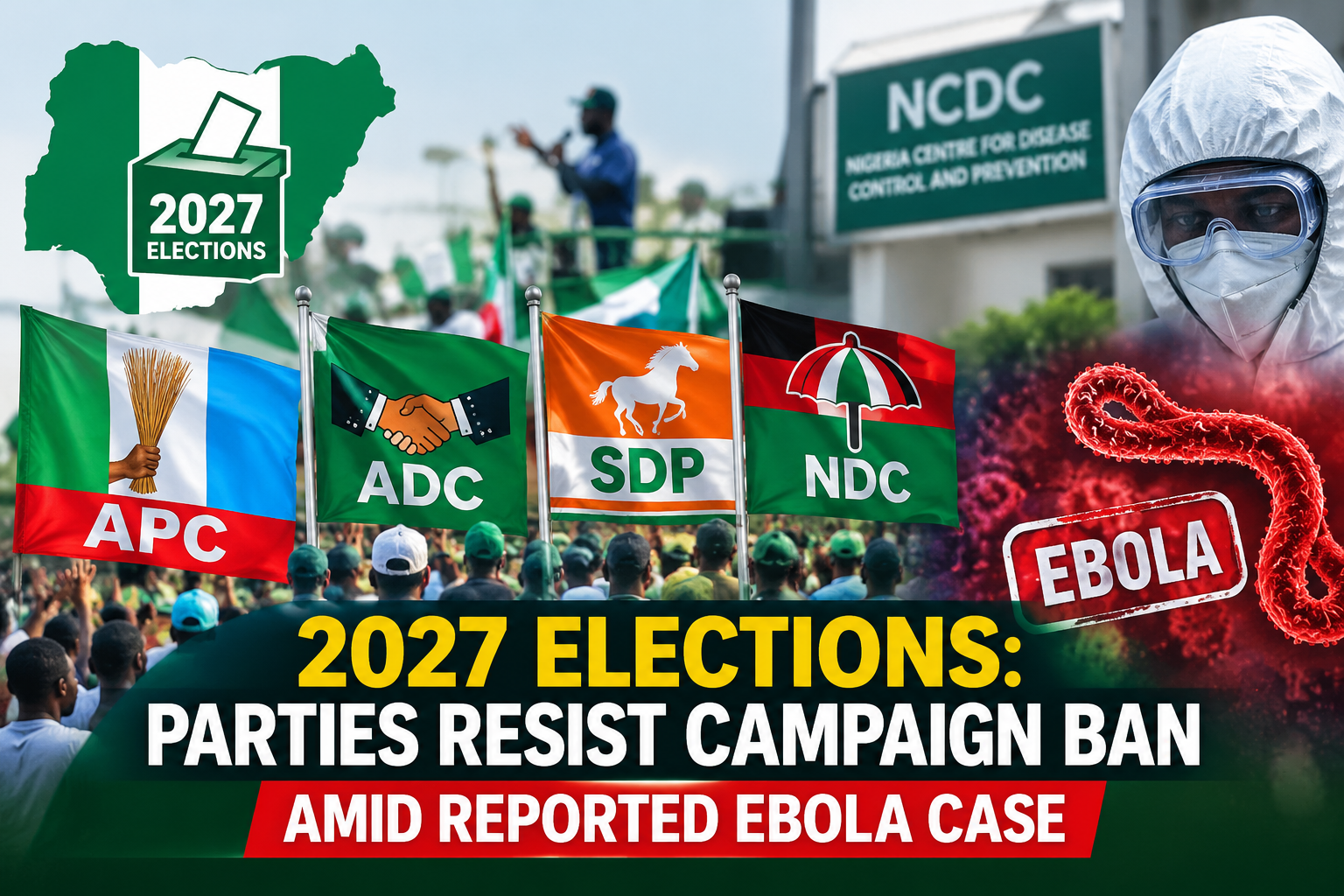
Some political parties in Nigeria have opposed calls to suspend campaign activities ahead of the 2027 general elections following a reported case of the Bundibugyo strain of Ebola virus disease in Abuja.
The parties maintained that political campaigns could continue under strict public health and safety protocols, arguing that appropriate preventive measures would help minimise the risk of transmission during rallies and other large gatherings.
The Coordinating Minister of Health and Social Welfare, Professor Muhammad Ali Pate, had said there was no immediate need to cancel political campaigns, conferences or other large public gatherings following the reported case.
The National Director of Publicity of the All Progressives Congress (APC), Bala Ibrahim, also urged Nigerians to remain calm, noting that the Nigeria Centre for Disease Control and Prevention (NCDC), the Federal Ministry of Health and other relevant agencies had issued advisories on the situation.
Ibrahim cautioned against politicising the health concern, warning that doing so could trigger unnecessary panic and confusion.
“Contagious disease or infectious diseases that require quarantine and proper investigation is not something that you subject to political discussion. This is a very technical issue and a sensitive one for that matter,” he said.
He added, “Let us not take the matter to the political arena where there will be panic, and there will be fear and confusion in the country.”
ADC Raises Concerns Over Possible Restrictions
However, the African Democratic Congress (ADC) expressed concern that the Federal Government could use the outbreak as a justification to restrict opposition parties from campaigning ahead of the 2027 elections.
The party’s National Publicity Secretary, Bolaji Abdullahi, told Sunday PUNCH that although protecting public health should remain a priority, any decision to restrict political activities must be based on clear and transparent public health considerations.
Abdullahi also linked the concern to President Bola Tinubu’s reported declaration that he would not be able to campaign, warning that other political parties should not be prevented from reaching voters under the pretext of containing the outbreak.
“The health of Nigerians should be the priority for everyone, but we also have to be very careful that we don’t create a situation for political opportunism,” he said.
“With President Bola Tinubu declaring that he will not be able to campaign, we are afraid that the federal government may now take advantage of this Ebola situation to shut down campaigns for other political parties as well.”
The ADC spokesman insisted that any proposed restrictions should be properly explained and justified.
“If they want to advise us not to campaign, they have to tell us why and then we will also raise other questions at the appropriate time,” he added.
SDP Calls for Stronger Preventive Measures
Similarly, the Social Democratic Party (SDP) opposed an outright suspension of political campaigns, calling instead for stronger disease surveillance and preventive measures to protect Nigerians.
The party’s National Publicity Secretary, Rufus Araba, said the reported Ebola case did not justify a blanket suspension of campaign activities as political parties prepared for the 2027 general elections.
Araba explained that candidates needed opportunities to engage voters, present their manifestos and communicate their policy proposals.
He maintained that political participation could continue alongside appropriate public health measures designed to reduce the risk of infection.
The party’s position reflects a preference for preventive action rather than a nationwide halt to political activities.
Nigeria Democratic Congress Advocates Safer Campaigns
The Nigeria Democratic Congress (NDC) also urged political parties to adopt safer campaign strategies, including measures to reduce physical contact at political gatherings, rather than suspend activities altogether.
The party’s Publicity Secretary in Lagos State, Olushile Akinyemi, told The Punch that suspending political activities without clear and transparent justification could deepen public suspicion.
He noted that such a decision could be particularly contentious amid existing distrust of the Independent National Electoral Commission (INEC) and the electoral process.
Akinyemi argued that political parties could modify their campaign methods to minimise the risk of infection while ensuring that candidates remained connected to voters.
“Campaigns should continue under strict safety protocols, and not be halted abruptly,” he said.
The parties’ positions highlight the need to balance public health protection with political participation as preparations for the 2027 elections continue.
What Happened to Nigeria’s Reported Ebola Case?
The disagreement over campaign activities comes amid growing public attention on Nigeria’s reported case of the Bundibugyo strain of Ebola virus disease.
The infected woman was identified as a Swiss national and the wife of a staff member at the Swiss embassy in Abuja.
According to information disclosed by the Swiss Foreign Ministry on Friday, October 23, the woman and her husband had travelled to Uganda approximately two weeks before the statement was issued.
Swiss authorities said the woman was believed to have contracted the virus during the trip, although the precise location of exposure remained under investigation.
The ministry also stated that neither the woman nor her husband had visited the Democratic Republic of the Congo, which is at the centre of the ongoing outbreak of the Bundibugyo strain.
“The Swiss woman, who is symptomatic, has been hospitalised for about a week at a private clinic in Abuja,” the statement said.
The woman’s husband was placed in isolation as a precaution but had not developed symptoms, according to the Swiss authorities. Other staff members at the embassy were also reported to be in good health.
Nigerian health authorities had earlier confirmed that the woman tested positive for the Bundibugyo strain after arriving in Abuja from Uganda on October 3 aboard Ethiopian Airlines Flight ET333.
Olajumoke Babatunde, Director of Public Health Laboratory Services at the NCDC, disclosed during an emergency meeting in Abuja on Wednesday, October 21, that laboratory investigations had confirmed the strain.
“We did three levels of tests, but all molecular. The strain was Bundibugyo,” Babatunde said.
NCDC Identifies 44 Contacts as Surveillance Intensifies
Following confirmation of the case, Nigerian health authorities intensified efforts to prevent further transmission.
Authorities identified 44 contacts linked to the patient, reportedly including healthcare workers, fellow patients, caregivers and individuals connected to her travel history.
The Federal Ministry of Health and Social Welfare, the NCDC and the FCT Health Services Secretariat are coordinating the response.
Health facilities and port health surveillance units across the country have also been placed on high alert as officials work to identify potential exposure risks and prevent further spread.
Contact tracing, laboratory testing, isolation where indicated and surveillance are important components of the response to suspected or confirmed Ebola infections.
The development has also increased attention on how political parties can conduct public engagements while following guidance issued by public health authorities.
What Is the Bundibugyo Strain of Ebola?
The Bundibugyo strain is a type of Ebola virus first identified during an outbreak in Uganda in 2007.
Ebola virus disease can cause severe illness and death. Transmission occurs primarily through direct contact with the blood or other bodily fluids of an infected person who has developed symptoms, as well as through contaminated materials.
Symptoms may include fever, severe weakness, headache, muscle pain and sore throat. Some patients may subsequently develop vomiting, diarrhoea and other serious complications.
The incubation period generally ranges from two to 21 days.
The disease is not ordinarily transmitted through casual contact with an infected person who has no symptoms, although people who have had a potential exposure should follow the advice of public health authorities.
Nigeria previously experienced an Ebola outbreak in 2014 after an infected traveller arrived in Lagos from Liberia. Health authorities successfully contained that outbreak.
Political Campaigns and Public Health in Focus
As political parties prepare for the 2027 general elections, the reported Ebola case has prompted debate over whether large political gatherings should continue and what preventive measures should be required.
While the APC has urged Nigerians to avoid politicising the health situation, the ADC, SDP and NDC have opposed a blanket suspension of campaigns, advocating transparency, stronger surveillance and safer campaign arrangements.
The central question is how to protect Nigerians from potential infection without imposing restrictions on political participation without a clear public health justification.
Any decisions on campaign gatherings will need to take account of official health guidance, the evolving epidemiological situation and the need to communicate preventive measures clearly to the public.